The Sense and Non-Sense of Revolt by Julia Kristeva
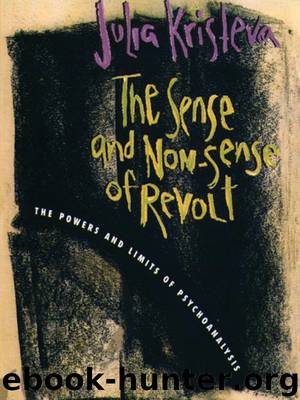
Author:Julia Kristeva
Language: eng
Format: epub
Tags: PSY026000, Psychology/Movements/Psychoanalysis, LIT000000, Literary Criticism/General
Publisher: Columbia University Press
Published: 2000-03-22T16:00:00+00:00
A Defense of Irène
I have just presented a few of surrealism’s antecedents and some problems concerning reality, the fantastic, the feminine, the occult, the rational: all problems that solicited the era’s imaginary, and particularly, Aragon’s imaginary. I stayed within a general framework, without going into the details of Aragon’s life, while pointing out the cross-links between his literary experience and the surrealist imaginary. Now I will deal with a few aspects of Aragon’s biography as well as the text La Défense de l’infini or rather the fragment that remains of it, Irene’s Cunt.
The “True Lie”
“At every instant, I betray myself, I refute myself, I contradict myself. I am not someone I trust,” the writer proclaims in “Révélations sensationnelles.”40 This will serve as an epigraph to what I have to say about Aragon, whose controversial persona you are certainly familiar with. It expresses the protean, polyphonic aspect of both the personage and the work, which he himself called “le mentirvrai” (the true lie): the ambition to tell the truth through a thousand disguises, masks, theatricality.41 There is more than one split in Aragon, who wrote sixty books in sixty years, almost as many as Hugo. He is a true feu d’artifice, the artifice no doubt imagined as a reflection of Baudelaire’s dandyism, “this simultaneous double postulation” signaling our own distorted, diminished, and mystified identities before the masquerade of society and the media.42
Indeed, Aragon’s personality, life, and work give the impression—call it subjective, or ontological; in any case, it seems unshakable—of never being univocal, of scattering in pastiche, simulacrum, and approximation, so many roundabout ways of expressing truth. This is the truth of an impossible identity, not a being in the world or a nonbeing but a continuous variation, both passionate and disappointed, bipolar, if you want technical terms, that the writer-seducer sums up prettily by speaking of words that “make love with the world.”43 This need for immersion/dissolution, taking possession/impotence, power/passiveness, virilization/feminization—you can change the terms of this plasticity as you like—no doubt responds to the incoherence or the impossibility of personal coherence manifested in the exaltation of the amorous act. This exaltation will take two forms: one, scandalous—Irene’s Cunt—the other, institutional—conjugal love and adherence to the French Communist Party.
A few biographical elements will allow you to situate this writer who is somewhat forgotten today.44 They may repel some and compel others, but they seem to offer, even today (perhaps more so today) a style and/or symptom (this is Lacan’s accolade) that is still valid. He was born October 3, 1897, and died December 24, 1982. We know about his mother, Marguerite Toucas, a single parent, and her sisters, Marie and Madeleine. In his autobiographical recollections—which are vague and cautious—Aragon often refers to the maternal configuration formed by his grandmother and her three daughters. Marguerite belonged to a bourgeois family of aristocratic descent through her paternal grandmother, who came from a family of Lombard petty nobles, the Biglione. Marguerite’s maternal grandmother was a “demoiselle Massillon,” a descendant of the famous prelate of Hyères.
Download
This site does not store any files on its server. We only index and link to content provided by other sites. Please contact the content providers to delete copyright contents if any and email us, we'll remove relevant links or contents immediately.
Unwinding Anxiety by Judson Brewer(73422)
The Art of Coaching by Elena Aguilar(53651)
The Fast Metabolism Diet Cookbook by Haylie Pomroy(21256)
Rewire Your Anxious Brain by Catherine M. Pittman(18797)
Healthy Aging For Dummies by Brent Agin & Sharon Perkins RN(17123)
Talking to Strangers by Malcolm Gladwell(13540)
The Art of Thinking Clearly by Rolf Dobelli(10719)
Mindhunter: Inside the FBI's Elite Serial Crime Unit by John E. Douglas & Mark Olshaker(9523)
Crazy Rich Asians by Kevin Kwan(9419)
The Compound Effect by Darren Hardy(9151)
Tools of Titans by Timothy Ferriss(8593)
Periodization Training for Sports by Tudor Bompa(8417)
Becoming Supernatural by Dr. Joe Dispenza(8368)
Wonder by R. J. Palacio(8241)
Bodyweight Strength Training by Jay Cardiello(8029)
Crystal Healing for Women by Mariah K. Lyons(8007)
Change Your Questions, Change Your Life by Marilee Adams(7931)
Nudge - Improving Decisions about Health, Wealth, and Happiness by Thaler Sunstein(7853)
Should I Stay or Should I Go? by Ramani Durvasula(7780)
